
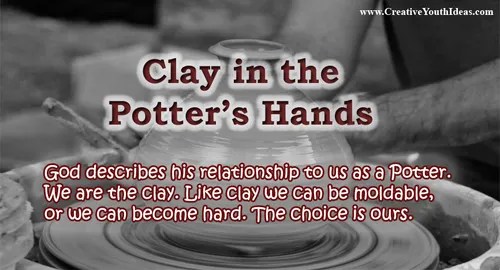
In Jeremiah chapter 18, God told the prophet to go down to the potter’s house, where he watched a man working with wet clay on two parallel wheels to form a pot. The lower wheel was operated by foot, and on the upper wheel he molded the slimy, mud-like substance to form a vessel. Jeremiah observed that sometimes the clay offered resistance, and so the potter had to rework the clay and begin again.
In this illustration, God is obviously the Master Potter and the clay represents us, his people. He skillfully molds us on the wheel of life into the people he created us to be, however painful that might be for us. Many times, because of our resistance, he has to rework the clay of our soul again and again, determined out of love to fashion us into his own image. He said, “Oh house of Israel, can I not do with you as this potter has done?”
God already sees us in our future perfected state, but it is only through trials and tribulations that we can hope to get there. In Acts 14, Luke writes, “It is through much suffering we enter the kingdom of God.” If we are not disciplined and corrected by the master potter, then Paul says we are “illegitimate sons.” He also said, “For this light affliction is preparing for us an eternal weight of glory beyond all comparison.” This is God’s primary means of sanctification, so that we are fit and equipped for the master’s use, not only for this world, but also for our future position in the glorious World to come. As Paul wrote to Timothy, “training for godliness promises benefits for this life, and also for the life to come.”
Who hasn’t at times longed for an easier way through this life? But Jesus said, “Narrow is the way and difficult it is to enter the kingdom of God.” But we can make this process less painful for ourselves by cooperating instead of chafing against his yoke. Unbelievers and most church people choose the easier way, but it is only easier for the present, because “broad and easy is the way to perdition.” This is not some kind of penance thing, as the Papists preach, but a well-documented biblical reality.
God told Jeremiah to form the clay into vessels, “as it seemed good to the potter to do.” Those words are critical. Just as the potter makes each pot for a specific purpose and function, so God fashions each and every soul independently, giving them unique and individual characteristics and giftings. Psalm 139 says, “For you formed my inward part; you knitted me together in my mother’s womb. I praise you, for I am fearfully and wonderfully made.” And Ephesians says, “For we are his workmanship, created in Christ Jesus for good works…” And Colossians says, “You have put on the new self which is being renewed in knowledge after the image of its Creator.” And in Corinthians, “We are being transformed into the same image of Christ.” These scriptures speak of the Master Potter’s genius in designing each of his created beings with unique personalities and temperaments.
The Book of Hebrews tells us that just as Jesus is the exact imprint of the Father, we are created in the exact image and imprint of Christ. For the first thirty years of my salvation experience, I knew this truth in my head from reading the Bible, yet in my former church group, ironically called “The Potter’s House,” I was taught something else from the pulpit. And so seeing myself as a unique creation of God had been distorted by another “gospel.” Their idea of believers being shaped into an image was not based on being formed into the image of Christ, but into an image of their own creation.
This subtle, sleight-of-hand technique allowed them to inoculate their followers into believing that submitting to their pastors was the same as submitting and being imprinted to Christ himself, and earning the pastor’s favor and approval was the same as earning God’s. I know this because I was once a pastor of some twenty years in that organization, and thus, I am equally guilty as charged.
The denominational leader of this group, who broke away from the Foursquare Gospel organization to establish his own denomination, offered the following illustration to explain his twisted ideology. Years earlier, while visiting a Dutch shoe-making factory, he observed the mass-production of wooden clogs. He watched as a block of wood was placed on a conveyor belt while a vinyl “shaper,’ which served as a prototype, was positioned just in front of it. Then, as each block of wood was processed through the cutting blades of an electrically powered machine, out the other side emerged identical wooden clogs.
With this experience fresh in mind, the above-mentioned leader proudly proclaimed he’d had an “epiphany”: this would be the goal of his discipleship program. The block of wood represented the fresh converts. The “shaper’ was the prototype of this leader’s interpretation of what a disciple should look and act like, and the identical wooden clogs represented the finished product, thus stripping the individual of their God-created uniqueness—one size fits all, which sounds more like something out of Orwell’s creepy 1984 novel than the transforming of a believer into the image of Christ. This group even had a phrase reinforcing this dehumanizing doctrine: “Following the pattern,” which, of course, was a pattern of their own creation. In so doing, they negated God’s word in Genesis, where he said, “Let us make man in our image, after our likeness.”
This process is so nuanced and subtle that the new believer is unwittingly indoctrinated into this false system of discipleship from the beginning of his church experience, imprinted by a man’s vision rather than a biblical one. And unless awakened by the liberating Spirit of God, he will be entrapped in this system, greatly dwarfing his spiritual growth and never truly discovering who he is in Christ. Thus, he becomes little more than a cog in a leader’s quest to mask his own insecurity and control issues. One such leader gave me a personal “prophecy” that I had a “wandering spirit,” which only meant he feared I was wandering too far out of his control. It has taken me almost twenty years to fully untangle this false imprinting and to see myself as Christ sees me.
In order to keep their congregants in spiritual servitude, little catchphrases were utilized to quell any independent thinking. For instance, “You think it’s just about you and Jesus.” And here I “foolishly” thought it was all about me and Jesus. What they meant was, “You can’t get personal inspiration or the mind of Christ directly from God; it all has to be filtered through your spiritual leaders. And another one: “God has an address,” meaning that if you left their church, you would never hear from God again and probably lose your salvation.
It reminded me of my days growing up as a Catholic, where we were told, “We couldn’t read the Bible on our own without the priest interpreting it for us.” This intrusive type of leadership is not that of a shepherd, but of a hireling, interjecting himself in between God’s Word and the believer. And God will hold them responsible. Woe to anyone who adds or subtracts or changes God’s Word to suit their own individual agenda.
This isn’t just about heavy-shepherding churches like the above-mentioned example, but it’s true of any group: Hipster churches that want their people to be hip like the pastor, yuppie churches, legalistic churches, charismatic churches, even the “frozen chosen” ones. I got saved in the “Jesus People Movement”; we didn’t know any better than just wanting to be like Jesus, which should be the goal of any ministry, not just to make people like themselves.
So, what about scriptures like Hebrews 13:17: “Obey your leaders and submit to them; for they keep watch over your souls, as those who will give account?” I believe in submission to authority, but not carte blanche. I don’t see in Scripture that a believer should give unconditional submission to anyone except God. God gave us a brain and discernment and expects us to use them. He never ordained spiritual leadership to be an authoritarian dictatorship, as if they were Old Testament kings rather than New Testament leaders. If a pastor is guilty of such leadership, indeed he will have to give an account for the damage he caused to those under him.
God expects us to be Bereans, that when we hear preaching or prophecy, we should, as Paul put it, “Let two or three prophets speak, and let the others pass judgment.” This is actually our responsibility. I’ve heard it said in my former group that if you submit to your spiritual leaders, even if it turns out to be in error and causes you to do the wrong thing, God will still bless it because you were submitted. And they actually say that with a straight face.
No, I don’t believe Jesus shed his precious Blood only for us to be imprinted after a mere man or some denominational organization. Paul wrote, “We all with unveiled faces are beholding as in a mirror the glory of the Lord and are being transformed into the same image from glory to glory.” This is the image I want to be transformed into. Paul also said in Romans 8 that we are “predestined to be conformed into the image of his Son.” And in 1Corinthians he said, “Just as humans bore the image of the man of dust, believers will bear the image of the Man of heaven.” Finally, Paul said in Ephesians, “We are called to put on the new self, created after the likeness of God in true righteousness and holiness.”
God spoke these words directly to Jeremiah. “Before I formed you in the womb I knew you, and before you were born I consecrated you; I appointed you a prophet to the nations.” This isn’t just about the prophet, but it’s for every human who has ever existed since the creation of Man. God has uniquely crafted every soul for a specific purpose, that they might become complete in him. He never intended for his created beings to be mass-produced according to some man-made, cookie-cutter discipleship program, and any such attempt is an affront to the Creator of the Universe. I was taught that this kind of individuality and uniqueness actually bordered on rebellion, but anything less is an abomination of God’s heavenly design.
If someone is formed into an image of a mere man rather than the image of God, would they not be risking God saying to them in the judgment, “I never knew you?” Because it’s very possible he wouldn’t recognize them.

