
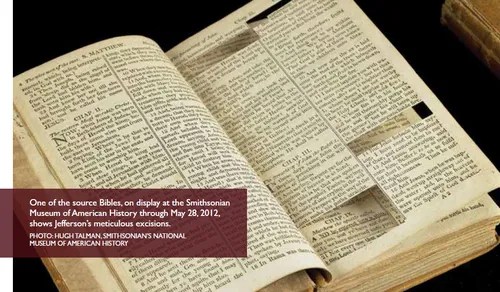
It is said that Thomas Jefferson didn’t believe in the supernatural, and so one day he took a penknife and cut out everything in his Bible that had to do with the miraculous. And then, just as Jehoiakim king of Judah did fourteen hundred years earlier, he tossed each successive clipping into the fireplace. It’s called the Jefferson Bible. I don’t know if this story is true or not, but I am aware of many others since who have virtually cut out large swaths of Scripture from their bibles, refusing to preach on certain subjects either because they don’t believe them or they found them inconvenient.
One of those large swaths that have downsized many of today’s Bibles is anything having to do with End Times prophecy and how it relates to the Church and the nation of Israel. Though more than two hundred verses in the New Testament and as much as one-third of the entire Bible deal with eschatology, these verses appear to have been lost to “Jefferson’s penknife.”
Why would anyone avoid preaching on prophecy and the End Times? I can only guess that some don’t want to be associated with the “doomsday, sandwich-board whackoes.” Leave it to the devil to raise up these latter-day charlatans in the first place, those date-setting, bearded, self-proclaimed oracles, resulting in the denigrating of any genuine, Scripture-based, End Times teachers. You know, those brave souls who would dare to include the books of Daniel and Revelations in their pulpits.
Another excuse I’ve heard for boycotting this subject is that preaching on prophecy is too confusing and difficult to understand. I read that as virtual-signaling that someone doesn’t want to make the effort to dig into the more complex and weightier parts of Scripture. Others, I’ve heard, don’t want to scare off or offend their congregations, but all they’re doing is cheating them out of the self-cleansing expectancy of the imminent return of Christ and the Rapture of the Church. And that we’ve been chosen to comprise the last generation of the Gentile Age, and that our future is far more glorious than anything we could hope for or imagine. Paul, a recent visitor to glory, said he heard things there that were so utterly Divine that a human tongue wasn’t worthy to utter them. Why would you not want to remind people of that kind of hope?
A second topic that avoids most sermon notes is the controversial subject of spiritual gifts. Controversial only because many of today’s preachers don’t believe in their present-day application, especially the power and vocal gifts, and so they gloss over them with nary a mention. And even many who are Spirit-filled downplay even the genuine, orderly expression of these gifts in their services for fear of appearing “too weird.” But they too are depriving their congregations, cheating them out of the full power of the Holy Spirit and the potential for individuals to express their gifts in order to build up the Body of Christ. Ever since Pentecost, the birth of the Church, every believer has been promised this power and giftings from Above, and if it wasn’t missing in action from many preacher’s teachings, they might be discovering their gifts and blessing the Church with them.
A third swath of Scripture that has gone absent without official leave is the subject of spiritual warfare. Paul warned, “We wrestle not against flesh and blood, but against the rulers, against the authorities, against the cosmic powers over this present darkness, against the spiritual forces of Evil in the heavenly places.” I’m not talking about chasing demons or mapping out your city, but how are believers to wrestle against cosmic forces of Evil if they aren’t even aware that they exist? Paul further wrote, “The weapons of our warfare are not of the flesh but have divine power to destroy strongholds.” Strongholds? What’s he talking about? “Resist the devil and he will flee.” The who?
This power and authority over the Evil one was given to us at the Great Commission. Without it, we’d have to call it the “Limited Commission.” One of our enemy’s greatest feats has been to get believers to ignore or deny that the devil even exists. And his strategy must be working, as a recent Barna survey revealed that almost 60% of self-proclaimed Christians don’t believe in a literal devil. And Google agrees. Is it any wonder that so many of God’s people feel defeated in their walks when they’ve been unknowingly thrust into a spiritual war zone completely unequipped?
These modern-day Jeffersonian Bibles have resulted in effectively shrinking God’s Word to about half its original size. It’s not that I believe these pastors don’t teach on other critical areas of Scripture, like salvation, repentance, forgiveness, thanksgiving, and such things, because I’ve heard them. But if I was Screwtape, I especially would not want them to teach on the power of Pentecost. I would want that subject buried somewhere in the distant, forgotten past. Bad enough these Christians come to church and go about doing some good works here and there without them shifting into another gear with the supernatural to aid them. And would the devil want believers to be focused on the return of Christ? No, he would want them sleepy, complacent, and with their lamps lacking oil. And why would that “old serpent” want believers to be enlightened about his nefarious activities in the world? He’s not called the “Prince of Darkness” for nothing. Better to let them keep their harmless, red-clad, cartoonish, Hollywood version rather than the real thing.
It’s not that believers can’t dig into these subjects on their own, but most don’t make the effort and just depend on their preachers to tell them what to believe. In Paul’s farewell speech to the Ephesian elders in Acts 20, he said in part, “Nor did I shrink from declaring to you the whole counsel of God.” Paul, rather than shrinking God’s Word, believed we should teach the entire revelation of Scripture without omitting or adding to it. Anything less would be a sin and a great disservice to the people God has entrusted to us.
 Changing from glory to glory