THOSE LAST FOUR WORDS

I’m not trying to embarrass this guy, or maybe I am, but there’s a certain pastor named Bill from Amarillo, Texas who gives a one-minute “Let’s Go Deeper” segment on a Christian radio station, so you may have heard of him. Now that I’ve outed him, I’d like to give him his due.

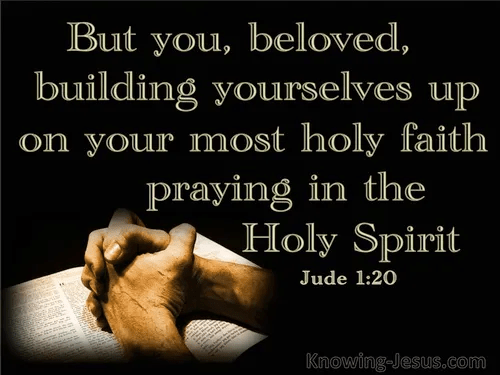
Pastor Bill said he was preaching his way through the book of Jude and then quoted verse 20, which reads in part, “But you, beloved, building yourselves up in your most holy faith…” If you’re wondering why I left off the last five words of that Scripture, it was purposeful, because in explaining this text, Pastor Bill also left it off.

And there lies the problem. Leaving off those last five words changes the whole meaning of Jude’s intent. I’m not living in Bill’s head so I don’t know if he just innocently misinterpreted this Scripture or if it’s intentional and he’s trying to avoid a subject he’s uncomfortable with, but when you go out of your way to eliminate part of the written Word, I suspect the latter. Now that we’ve exposed his crime, let’s look at his takeaway from this aborted text. Bill asks the question. “How do we build ourselves up in our most holy faith?” Great question. The answer would have been obvious to him if he hadn’t cut off those last five words.

But he did. And then instead, Bill takes us on a detour and redirects us to Acts 20:32, which has Paul speaking to the Ephesian elders: “And now I commend you to God and to the Word of his grace, which is able to build you up.” Then, Bill does a virtual cut and paste from Acts 20 and attaches it to Jude 20 and creates his own version of Jude’s words. According to Bill’s new translation, we are built up in Christ by the “words of his grace.”

True. But we are also built up in corporate worship and by Christian fellowship and by someone close to us being converted to Christ and by a whole host of other things. Though we are certainly built up by the “words of his grace,” Jude was speaking specifically about something different. In case you haven’t already read those last five words, I’ll let Jude give them to you now. They are, “PRAYING IN THE HOLY SPIRIT.” So, the completed verse would read, “But you, beloved, building yourselves up in your most holy faith, praying in the Holy Spirit.” Elsewhere, Paul defines “praying in the Holy Spirit” as “praying in tongues.”

And so you see why this is such a big deal. It’s not like if you don’t like the plain interpretation of something, you can just translate it differently to suit your own taste just because you’ve got the pulpit. The JW’s know all about that. And then there’s that thing about not adding or subtracting from the Word of God. I’m pretty sure that would include cutting and pasting parts of it.

After the Resurrection and just before he ascended back to heaven, Jesus gave his final instructions to the disciples: First, the Bible says, “He breathed on them and said, ‘Receive the Holy Spirit.’” At this point, they were spiritually reborn and received the indwelling Spirit that comes with salvation. Then, a little later, he instructed them further: “And behold, I am sending the promise of the Father upon you. But stay in the city until you are clothed with power from on high.” So, in addition to receiving the indwelling Spirit upon salvation, he said that forty days later at Pentecost they would receive the baptism of the Holy Spirit and be “clothed with power from on high.”

This is just the plane, straightforward reading of the text. You don’t have to be a Bible geek or have a Greek and Hebrew lexicon to understand it. You don’t need the fifty-six-volume Bible Illustrator commentary to arrive at the proper interpretation. And you don’t need a master’s degree in theology to understand this, though that in itself these days might be a hindrance. And you certainly don’t want to fuse two unrelated texts together in order to pretend they mean something else, as Pastor Bill appears to have done.

And Bill’s not alone. Countless Bible teachers avoid these biblical truths like black mold on a toilet seat, One such teacher said, “Paul’s letter to the Corinthians was to get them off the kick of speaking in tongues.” I guess then Paul would have to kick the habit also, since he said, “I speak in tongues more than you all.” Another said, “The gift of tongues is not given for personal enrichment.” Again, we’d have to believe that Paul spoke a lot in tongues but was never enriched by the experience. And my favorite: “Jesus didn’t speak in tongues.” I even once had a pastor mock the use of tongues from the pulpit while looking angrily down at me. Yikes, with everyone clapping and praising God in this mega church, how did he know it was me? And this was in a self-proclaimed Pentecostal church. Go figure.

“The devil comes to steal, kill, and destroy.” To me, one of Satan’s most successful and devastating thefts has been his robbing the Church of the baptism of the Holy Spirit. The result of this theft is that without this original juice, most of Christendom has become stuffed up with religiosity and programs substituting for the power of God, and some are even denying the faith altogether. This theft has robbed the Church of the main thing that makes it a Church, the full, energizing power of the Holy Spirit to overcome in these perilous, waning days of the Laodicean Church Age.

As the song goes, “These are the days that we’ve been waiting for, all of our lives.” These are the days the prophets eagerly looked forward to. The blueprint we were given at Pentecost wasn’t meant to just strap us into the starting blocks and then have us quit the race after a quick sprint. Are we to believe that God didn’t want us to have all his spiritual weapons in our arsenal and the fullness of his power to make it to the finish line?

THE DUAL PURPOSE OF TONGUES

What Is The Baptism Of The Holy Spirit

In this final blog on the baptism of the Holy Spirit, I want to explain the two different types of speaking in tongues. Even among some bona fide Pentecostals there is some confusion on this. The first type is for prophecy, tongues that need to be interpreted. If there is no interpretation, the speaker should be silent or pray that he could interpret the message himself. The second is for a personal prayer language, not to be used in the church assembly but should only be exercised in one’s private prayer closet.

Paul differentiated between these two functions in his first letter to the Corinthians. It needs to be said that the church at Corinth was the most fleshly, carnal of all first-century churches, even more carnal than your average evangelical church in America today. In one instance, a young man was sleeping with his stepmother. Even the Methodists don’t allow for that. Though this violated the Old Testament and Roman laws of the day, apparently no one thought it a big deal. In fact, they were rather proud of it, perhaps a chance to prove their wokeness. And when Paul chastised them for their depravity, they thought he was a little over the top about it. And when it came to the Lord’s Table, instead of using it to remember Christ’s death and resurrection, some were celebrating the wine far more than others and treated the sacrament with all the reverence of a bachelor party at Buffalo Wild Wings.

These fleshly, carnal Corinthians were also abusing the gift of tongues, disrupting the church services by randomly blabbering away, possibly after having guzzled too much of that Communion wine. They are not unlike the present-day hypercharismatics and their “out-of-control” manifestations, that serve to violate Paul’s command to “let all things be done decently and in order.” So Paul admonished the tongue-talkers for their foolishness and told them to keep quiet in the church unless there was someone there who could interpret them for the benefit of all.

So, the first function of tongues is prophetic and requires an interpreter. The second function is that of a prayer language. Paul contrasted these two uses when he wrote, “The one who prays in a tongue edifies himself, but the one who prophesies builds up the church.” In writing of his personal prayer life, Paul wrote, “If I pray in a tongue, my spirit prays but my mind is unfruitful … so, I will pray in the Spirit and also with my understanding.” This kind of prayer tongues are for those times when mere words are inadequate to express our deepest needs and desires. Paul explains this in Romans 8: “Likewise the Spirit helps us in our weakness. For we do not know what to pray for as we ought, but the Spirit itself intercedes for us with groanings too deep for words,,, because the Spirit intercedes for the saints according to the will of God.”

Praying in tongues is also a powerful means of personal edification. As Jude put it, “… but you, beloved, building yourselves up in your most holy faith, praying in the Holy Spirit.” This is not a selfish exercise, but a gift God wants every believer to have so they can have more of his presence and for additional power to carry out the work he has given us to do. It’s like salvation on espresso.

Those who want to criticize the gift of tongues like to emphasize the texts that say, “The one who prophesies is greater than the one who speaks in tongues.” And that speaking in tongues is “the least of the gifts,” as if this gift had little worth at all. But is any gift from God not of supreme value? Paul left no doubt about his personal dependence on tongues when he wrote, “I speak in tongues more than you all.” I would encourage those who have built a wall of defense around tongues through their own various interpretations to lower their guard and ask God to reveal this gift to them.

Paul is writing this not to lessen the importance of this personal prayer language, but to amplify the importance of building up the whole church, which is the primary aim of all spiritual gifts. He said, “Each is given the manifestation of the Spirit for the common good.” But there is also an important place for the God-given praise and prayer language so that Spirit-filled believers can “build themselves up in their most holy faith, praying in the Holy Spirit.”

I hope this helps you to better understand this complex subject. It’s not actually that complex—it’s quite straightforward. Unfortunately, those who want to relegate all Spiritual gifts to the distant past have muddied the waters for those who have followed their teachings.

RELIGHTING THE FIRES OF PENTECOST

Paul said in his first letter to the Corinthian church, “Now concerning spiritual gifts, brothers, I do not want you to be uninformed.” One of Paul’s greatest fears, besides his fear that his fellow Jews would fail to come to Christ, is that the power of the spiritual gifts, especially the sign gifts, would eventually be lost to the Church. But then, less than three hundred years after Paul’s letter, most churches have become just that.

The other day I did an internet search for churches in my city that claim to be “Spirit-filled” or “Full Gospel.” Unfortunately, over time, these terms have been so compromised that today they can mean anything from being jacked up on caffeine in the church bistro, to having a sugar rush from the glazed donuts, to having an ultra-animated church greeting committee, or even having an electric guitar in the worship service.

According to my research, the Unitarians and the Presbyterians are considered “Spirit-filled.” Regrettably, this term has lost most of its original punch, unless these groups have suddenly had an Azuza Street-type revival that I wasn’t aware of. Out of over one hundred churches in my city, there were only two that actually believed in the “baptism of the Holy Spirit and fire” that Jesus promised to every believer in Luke 3:16. This is exactly what Paul feared for his Corinthian believers.

In his book, Charismatic Gifts in the Early Church, Ronald N. Kydd exposes one of the most common myths about why some believe the sign gifts have ceased. He writes that as the Christian community in the 3rd Century grew in size, wealth, and social acceptance, the gifts of the Spirit just quietly slipped away. This started in 313 A.D. with the passing of the Edict of Milan, an agreement between Emperor Constantine of the Western Roman Empire and Emperor Licinius of the Eastern Roman Empire, resulting in them changing their policy towards Christians, essentially ending persecution and giving the Church legal status. If the fires of Pentecost had not been extinguished in the 3rd century, we could have likely avoided the 1000 years known as the “Dark Ages.”

In other words, as the believers were no longer enduring the fires of persecution, their spiritual temperatures cooled, and their hearts and minds shut down to their need for the supernatural power of the Holy Spirit. So, it wasn’t that the gifts ceased, as many have claimed, limiting them to the Apostolic Age only, but because the Church at large didn’t think they needed them anymore.

So, the sign gifts didn’t just fade away or cease to exist, but they were simply written off by most of the Church world because they had grown self-sufficient, and so like many churches still today, they reflect another one of Paul’s letters when he said they would have “an appearance of godliness, but they would deny its power.”

My hope is that these sign gifts of the Spirit be returned to the Church, where Paul intended them to be. In this present-day Laodicean Church Age, any talk of having a last day’s revival is improbable. But any talk about having such a revival without relighting the fires of Pentecost is absurd.

In a world that is experiencing a foretaste of the Apocalypse, maintaining one’s personal walk with Christ is a unique challenge. Witnessing firsthand the absolute End Time’s Evil, long-hidden but now rising out of the shadows, we need to breathe in the power of Pentecost as never before.