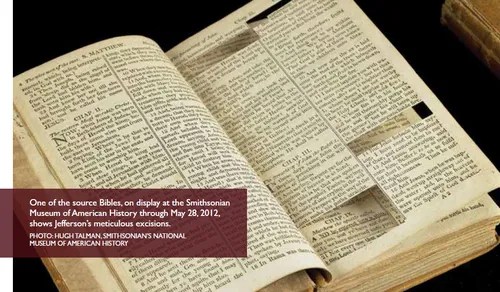
JEFFERSON’S BIBLE

It is said that Thomas Jefferson didn’t believe in the supernatural, and so one day he took a penknife and cut out everything in his Bible that had to do with the miraculous. And then, just as Jehoiakim king of Judah did fourteen hundred years earlier, he tossed each successive clipping into the fireplace. It’s called the Jefferson Bible. I don’t know if this story is true or not, but I am aware of many others since who have virtually cut out large swaths of Scripture from their bibles, refusing to preach on certain subjects either because they don’t believe them or they found them inconvenient.

One of those large swaths that have downsized many of today’s Bibles is anything having to do with End Times prophecy and how it relates to the Church and the nation of Israel. Though more than two hundred verses in the New Testament and as much as one-third of the entire Bible deal with eschatology, these verses appear to have been lost to “Jefferson’s penknife.”

Why would anyone avoid preaching on prophecy and the End Times? I can only guess that some don’t want to be associated with the “doomsday, sandwich-board whackoes.” Leave it to the devil to raise up these latter-day charlatans in the first place, those date-setting, bearded, self-proclaimed oracles, resulting in the denigrating of any genuine, Scripture-based, End Times teachers. You know, those brave souls who would dare to include the books of Daniel and Revelations in their pulpits.

Another excuse I’ve heard for boycotting this subject is that preaching on prophecy is too confusing and difficult to understand. I read that as virtual-signaling that someone doesn’t want to make the effort to dig into the more complex and weightier parts of Scripture. Others, I’ve heard, don’t want to scare off or offend their congregations, but all they’re doing is cheating them out of the self-cleansing expectancy of the imminent return of Christ and the Rapture of the Church. And that we’ve been chosen to comprise the last generation of the Gentile Age, and that our future is far more glorious than anything we could hope for or imagine. Paul, a recent visitor to glory, said he heard things there that were so utterly Divine that a human tongue wasn’t worthy to utter them. Why would you not want to remind people of that kind of hope?

A second topic that avoids most sermon notes is the controversial subject of spiritual gifts. Controversial only because many of today’s preachers don’t believe in their present-day application, especially the power and vocal gifts, and so they gloss over them with nary a mention. And even many who are Spirit-filled downplay even the genuine, orderly expression of these gifts in their services for fear of appearing “too weird.” But they too are depriving their congregations, cheating them out of the full power of the Holy Spirit and the potential for individuals to express their gifts in order to build up the Body of Christ. Ever since Pentecost, the birth of the Church, every believer has been promised this power and giftings from Above, and if it wasn’t missing in action from many preacher’s teachings, they might be discovering their gifts and blessing the Church with them.

A third swath of Scripture that has gone absent without official leave is the subject of spiritual warfare. Paul warned, “We wrestle not against flesh and blood, but against the rulers, against the authorities, against the cosmic powers over this present darkness, against the spiritual forces of Evil in the heavenly places.” I’m not talking about chasing demons or mapping out your city, but how are believers to wrestle against cosmic forces of Evil if they aren’t even aware that they exist? Paul further wrote, “The weapons of our warfare are not of the flesh but have divine power to destroy strongholds.” Strongholds? What’s he talking about? “Resist the devil and he will flee.” The who?

This power and authority over the Evil one was given to us at the Great Commission. Without it, we’d have to call it the “Limited Commission.” One of our enemy’s greatest feats has been to get believers to ignore or deny that the devil even exists. And his strategy must be working, as a recent Barna survey revealed that almost 60% of self-proclaimed Christians don’t believe in a literal devil. And Google agrees. Is it any wonder that so many of God’s people feel defeated in their walks when they’ve been unknowingly thrust into a spiritual war zone completely unequipped?

These modern-day Jeffersonian Bibles have resulted in effectively shrinking God’s Word to about half its original size. It’s not that I believe these pastors don’t teach on other critical areas of Scripture, like salvation, repentance, forgiveness, thanksgiving, and such things, because I’ve heard them. But if I was Screwtape, I especially would not want them to teach on the power of Pentecost. I would want that subject buried somewhere in the distant, forgotten past. Bad enough these Christians come to church and go about doing some good works here and there without them shifting into another gear with the supernatural to aid them. And would the devil want believers to be focused on the return of Christ? No, he would want them sleepy, complacent, and with their lamps lacking oil. And why would that “old serpent” want believers to be enlightened about his nefarious activities in the world? He’s not called the “Prince of Darkness” for nothing. Better to let them keep their harmless, red-clad, cartoonish, Hollywood version rather than the real thing.

It’s not that believers can’t dig into these subjects on their own, but most don’t make the effort and just depend on their preachers to tell them what to believe. In Paul’s farewell speech to the Ephesian elders in Acts 20, he said in part, “Nor did I shrink from declaring to you the whole counsel of God.” Paul, rather than shrinking God’s Word, believed we should teach the entire revelation of Scripture without omitting or adding to it. Anything less would be a sin and a great disservice to the people God has entrusted to us.

THE DUAL PURPOSE OF TONGUES

What Is The Baptism Of The Holy Spirit

In this final blog on the baptism of the Holy Spirit, I want to explain the two different types of speaking in tongues. Even among some bona fide Pentecostals there is some confusion on this. The first type is for prophecy, tongues that need to be interpreted. If there is no interpretation, the speaker should be silent or pray that he could interpret the message himself. The second is for a personal prayer language, not to be used in the church assembly but should only be exercised in one’s private prayer closet.

Paul differentiated between these two functions in his first letter to the Corinthians. It needs to be said that the church at Corinth was the most fleshly, carnal of all first-century churches, even more carnal than your average evangelical church in America today. In one instance, a young man was sleeping with his stepmother. Even the Methodists don’t allow for that. Though this violated the Old Testament and Roman laws of the day, apparently no one thought it a big deal. In fact, they were rather proud of it, perhaps a chance to prove their wokeness. And when Paul chastised them for their depravity, they thought he was a little over the top about it. And when it came to the Lord’s Table, instead of using it to remember Christ’s death and resurrection, some were celebrating the wine far more than others and treated the sacrament with all the reverence of a bachelor party at Buffalo Wild Wings.

These fleshly, carnal Corinthians were also abusing the gift of tongues, disrupting the church services by randomly blabbering away, possibly after having guzzled too much of that Communion wine. They are not unlike the present-day hypercharismatics and their “out-of-control” manifestations, that serve to violate Paul’s command to “let all things be done decently and in order.” So Paul admonished the tongue-talkers for their foolishness and told them to keep quiet in the church unless there was someone there who could interpret them for the benefit of all.

So, the first function of tongues is prophetic and requires an interpreter. The second function is that of a prayer language. Paul contrasted these two uses when he wrote, “The one who prays in a tongue edifies himself, but the one who prophesies builds up the church.” In writing of his personal prayer life, Paul wrote, “If I pray in a tongue, my spirit prays but my mind is unfruitful … so, I will pray in the Spirit and also with my understanding.” This kind of prayer tongues are for those times when mere words are inadequate to express our deepest needs and desires. Paul explains this in Romans 8: “Likewise the Spirit helps us in our weakness. For we do not know what to pray for as we ought, but the Spirit itself intercedes for us with groanings too deep for words,,, because the Spirit intercedes for the saints according to the will of God.”

Praying in tongues is also a powerful means of personal edification. As Jude put it, “… but you, beloved, building yourselves up in your most holy faith, praying in the Holy Spirit.” This is not a selfish exercise, but a gift God wants every believer to have so they can have more of his presence and for additional power to carry out the work he has given us to do. It’s like salvation on espresso.

Those who want to criticize the gift of tongues like to emphasize the texts that say, “The one who prophesies is greater than the one who speaks in tongues.” And that speaking in tongues is “the least of the gifts,” as if this gift had little worth at all. But is any gift from God not of supreme value? Paul left no doubt about his personal dependence on tongues when he wrote, “I speak in tongues more than you all.” I would encourage those who have built a wall of defense around tongues through their own various interpretations to lower their guard and ask God to reveal this gift to them.

Paul is writing this not to lessen the importance of this personal prayer language, but to amplify the importance of building up the whole church, which is the primary aim of all spiritual gifts. He said, “Each is given the manifestation of the Spirit for the common good.” But there is also an important place for the God-given praise and prayer language so that Spirit-filled believers can “build themselves up in their most holy faith, praying in the Holy Spirit.”

I hope this helps you to better understand this complex subject. It’s not actually that complex—it’s quite straightforward. Unfortunately, those who want to relegate all Spiritual gifts to the distant past have muddied the waters for those who have followed their teachings.

THE DEATH OF PENTECOST

Paul said in 1 Corinthians 12:1, “Now concerning spiritual gifts, brothers, I do not want you to be uninformed.” Unfortunately, today, that is what most teachers and believers are, misinformed about spiritual gifts, in particular, the sign gifts. In this blog, I’m only going to address the baptism in the Holy Spirit with the outward evidence of speaking in tongues, or what I’ll refer to here as “the power of Pentecost.” And why is the subject of the power of Pentecost so critical, I mean, it’s not a matter of one’s salvation, right?

Or is it? And no, I do not believe that baptism in the Holy Spirit with the evidence of speaking in tongues is necessary for salvation. In a future blog, I will deal with the indwelling Spirit that comes into every believer upon salvation, but for now, I am speaking of what’s been called “the second blessing.”

How many believers today are weak in their faith because the power of Pentecost has been denied them? Jesus promised this power to every believer when He said, “John baptized with water, but you will be baptized with the Holy Spirit.” I believe this is Satan’s most successful attack against the church, convincing many otherwise brilliant theologians and pastors that this power is no longer available for the New Testament church. The vast majority of pastors ignore it altogether, relegating it to a distant past Age, leaving their people uninformed or misinformed. In a world that wants to put tampon dispensers in schoolboys’ bathrooms, and where young people are being surgically mutilated in the name of gender fluidity, one’s spiritual survival and sanity are clearly under attack. And how many struggling souls have been seduced back into the cultural sludge of this generation, into the flesh and perdition of this world for lack of the power of God to help them overcome?

Another way Pentecost has been killed is by what I refer to as the “hyper-charismatics,” commonly demonstrated by middle-aged, uncovered, attention-seeking women, swooning and shaking and laughing and crying “in the spirit” until they’re so overcome they go down “slain in the spirit.” Anytime a spirit renders a person “out-of-control,” they’re not under the power of the Holy Spirit; they’re being controlled by a demon spirit. I like how one well-known evangelist dealt with such manifestations, he instructed his ushers to take the person aside and cast the demon out of them. This false movement has done more to demonize the word “Pentecostalism” than any other single attack from hell.

The most common misinformation concerning the present-day gifts of the Spirit is that they passed away when the disciples passed on, by the end of the 1st century, and so they are no longer available or needed in our present world. These people are called “cessationists,” believing the power of Pentecost is no longer needed in our present Age. If this were true, then we’d have to believe that Christ, knowing that these Last Days would be the most wicked times since He walked the earth, didn’t think we would need the spiritual gifts to make it through to the End. Is this present-day Laodicean church Age so arrogant that they actually believe we no longer need this spiritual power? That would explain why most churches fulfill a Last Day’s prophecy that says many will “have a form of godliness but deny the power thereof.” Is it any wonder that Jesus doubted that when He returned, would He even “find faith on the earth?” I know that seems harsh, but I have a passion to see the power of God restored in this present Age.

The basis for the cessationist’s denial of present-day Pentecost comes from a lame interpretation of several verses in 1 Corinthians 13. They read, “As for prophecies, they will pass away; as for tongues, they will cease; as for knowledge, it will pass away. When I was a child, I spoke like a child, I thought like a child, I reasoned like a child. When I became a man, I gave up childish ways. For now we see in a mirror dimly, but then face to face. Now I know in part; then I shall know fully, even as I am fully known.”

Cessationists believe that the spiritual gifts passed away when we received the completed Bible, and thus, we no longer see dimly through a mirror since now we have the Word of God. And that before this, we spoke and understood in childish ways, but now that we have the Word, we no longer know “in part” but we now know “fully.” I wish that were true, but when I read the Word, unfortunately, like all others, I still only know “in part,” though I hope to be learning more and more as I continue reading and studying and growing and changing from glory to glory. But I don’t know “fully” yet, and neither does anyone else.

This interpretation, especially falls short when Paul says that we will have this fullness when we see it “face to face.” Face to face with what, with whom? The Bible? That seems like a strange way to talk about the Bible. My Bible doesn’t have a face, just a cover and lots of pages, but no face. This is obviously not talking about receiving the completed Word, but the Word of God Himself and when we see Jesus “face to face.” And when do we see him “face to face” but when we get to heaven? Paul is clearly saying the obvious, that we won’t need spiritual gifts after we get to heaven, because only there we will have the full revelation of Jesus Christ.

Finding a church today that teaches and demonstrates the power of Pentecost, and one that teaches the whole counsel of God, including the End Times, is almost impossible. I know it took my wife and I years. As we clearly see the signs of the Times pointing to the soon return of Christ for His Church: the sudden resurgence of worldwide antisemitism and the hatred of the nations of Ezekiel 38 and their “river to the sea” vitriol for Israel, and the rise of a one world economic, religious, and political system, controlled by the likes of Klaus Schwab and Bill Gates, setting the stage for the soon appearing of the antichrist, we can no longer afford to be misinformed about this power Christ has given to the Church in Acts 1:8.

Paul also lived in extremely perilous times, with heavy persecution and believing in the soon return of Christ. He said, referring to his prayer closet, “I thank God that I speak in tongues more than all of you … What am I to do? I will pray with my spirit, but I will pray with my mind also; I will sing praise with my spirit, but I will sing with my mind also.” More than ever, we need the power of Pentecost not only to survive but to be all God wants us to be in these End Times. As Jude said, “But you, beloved, building yourselves up in your most holy faith and praying in the Holy Spirit.”

Poking God’s Eye

My final book of “The Immortal Blood” series, “Poking God’s Eye” has just been released. You can order the e-book or the paperback version by clicking the link below.

https://books2read.com/PokingGodsEye

Who doesn’t have questions about the bizarro new world of chaos and madness we’ve suddenly been thrust into, and who are the major players behind this present-day global, mental, and spiritual meltdown? And how did the word “transhuman” slide so smoothly into our vocabulary? What do the terms “medical emergency,” “digital currency,” “climate change,” and the “Jan.6 ‘insurrection'” all have in common other than using up too many quotation marks?  And further, will Oliver’s voice-change give him the boldness he needs to win Heidi’s heart?

With all the characters from the Appleby tribe that you’ve grown to know and love in the first two books, “A Wife Worth Living,” and “The Blood of Champions,” this 320-page final installment of the “Immortal Blood” trilogy goes right to the sow’s teat on some of the most timely issues of our day. By time traveling to a Nazi concentration camp and witnessing a human medical experiment, to visiting the Tuskegee Institute, where unsuspecting, rural, southern Blacks were used to gauge the spread of untreated syphilis in the human male, “Poking God’s Eye” exposes the long history of the use of human medical experiments and their catastrophic consequences, including the untimely deaths of millions of innocent victims from the injection of “safe and effective” vaccines, all under the guise of protecting our health.

These novels were written with you, the reader, in mind, both to entertain and amuse, because I felt it would be the best way to deal with these dire, apocalyptic events without depressing you. But most importantly, these books were written to inform and warn and to offer the reader the ultimate means of escape from the End Times Tribulation that is soon to engulf the entire world. And not just to escape, but how to enter into a glorious future that lay just beyond this horrendous, present-day scenario. From such unlikely heroes as a Grand Kahuna from the Apostolic Family of Light and Wisdom, to a time-traveling 19th-century old man who makes random cameo appearances bringing messages from Above, to a discredited pathologist, who was banned from Twitter, imprisoned on Facebook, and put on Homeland Security’s Top 15 watchlist, the exciting conclusion of this time traveling thriller plays out in real-time. And, as a special bonus, you’ll discover why a newlywed couple’s honeymoon was interrupted by a time-traveling visit into the Tribulation Period.

About the Author

Alan Kern was a full-time pastor, missionary, and evangelist for twenty-five some years, pioneering and pastoring churches in the U.S., Canada, and South Africa. He now lives with a beautiful wife of thirty-four years on the Oregon coast and writes novels based on his experiences and imagination, including When Elephants Fight, A Wife Worth Living, The Blood of Champions, and his latest, Poking God’s Eye.   

THE BLUEPRINT

Having been birthed in the rich soil of a healthy, biblical church environment, until it turned into a heavy-shepherding Christian cult, I have been blessed to experience what I believe the Church was meant to be, starting with Pentecost. I have also been able to minister in this biblical pattern in my own ministry, especially in our tent church in South Africa, where we saw many conversions and healing miracles. Now, retired, I have observed a multitude of other church structures over the years and have not seen that pattern duplicated, and I find myself in the words of Crosby, Still, and Nash, trying to “get back to the Garden.”

This is what I believe. The End Times, remnant church, what’s left of its tattered self, will never be popular with the world, or even with the rest of the church world. For those holding out hope that the Church is going to rise up, defeat Evil, and transform the world, making it ready for Christ to return, isn’t it getting tiring by now having to keep pumping something up that won’t hold air? Statistics say that church attendance in America has been rapidly declining, not increasing, but then that may be a good thing, seeing as how most of the churches themselves are only offering religion. This is a far cry from what Jesus meant for His Church when he said, “I will build my church and the gates of hell shall not prevail against it.” So far, the gates of hell have done a pretty good job of crippling, perverting, diluting, and relegating much of the church world to impotence and irrelevancy.

     What did God intend for His Church? In John 17, Jesus pleaded with His Father concerning His greatest desire for His Bride: that they would be unified as one in purpose and spirit. Four times in this chapter He said things like, “that they may all be one, just as you, Father, are in me, and I in you, that they also may be like us.”  Paul added in Ephesians that we should be “eager to maintain the unity of the Spirit in the bond of peace.” And to the Philippians he said that we should be “standing together in one spirit, with one mind, striving side by side for the faith of the gospel.”

     This is not about the present-day ecumenical movement of the World Council of Churches, taking the likes of Mormonism, Jehovah’s Witnesses, and Catholicism, and combining them with all the other false religions of the world, until they’re all unified around nothing more than their own subjective “truths.” Or like the recent interfaith movement taking up the “Pride’ mantel, virtually signaling their allegiance to the soon upcoming system of the Beast. This is the religion of Babel, of Babylon, and eventually, the one-world religion of the antichrist.

     So, what’s happened to get us off course? The Early Church in persecution was doing fine, never better. Not that I’m advocating for more of the same. Then, after getting “legalized” and accepted by the State, it became compromised and religionized until it was murdered by the cult of Romanism, whereby the Church went into a one-thousand-year period called the “Dark Ages.” It reemerged with Martin Luther, who broke away from Romanism, and over time, the original “gifts of the Spirit” began seeping back in, along with conversions and the power of Pentecost, and they began looking more like the original Church of Acts.  

     The Evil one couldn’t let this stand. Since his primary target has always been God’s people, be they Jew or Gentile, he succeeded in getting the revitalized Church to divide into denominations, and even the non-denominational became their own separate denominations. Most allowed themselves to be lobotomized, severing their connection to the power of Pentecost, and now “having a form of godliness but denying its power,” they have been divorced from their biblical roots until they fit the Lord’s warning, “can a bad tree produce good fruit?”

     So, what should the Church be unified around? It’s not like we weren’t given a blueprint to follow. It’s not as if the Book of Acts had somehow been deleted from the Bible, although most of Christendom has done just that, relegating its power and miracles to a distant past. God made it easy for us; Luke even gives us an eyewitness account of the early Church: “And they continued steadfastly in the apostle’s doctrine…” (Acts 2:42). Luke didn’t say, “Just make it up as you go along.” He didn’t say, “If you don’t like a particular doctrine, if it makes you feel uncomfortable, just write it off as something of the past.” He didn’t say, “If your denomination doesn’t believe that way, then just ignore the Scriptures and go along with their doctrines. It’s like the Church has thrown out the blueprints and invented their own version of Christianity, doing “that which seemed right in their own eyes.”

     Again, what should the Church be unified around? The pattern left for us is not some deep mystery buried deep within the book of Leviticus or the Dead Sea Scrolls. It’s found in plain sight in the Book of Acts, where the Church was born on the Day of Pentecost, the original imprint. They believed the baptism of the Holy Spirit to be a separate experience from the Spirit of God that comes to dwell in every believer’s heart upon salvation. In Acts 19, Paul asked the Ephesian believers, “Did you receive the Holy Spirit when you believed?”

These Ephesians were already believers, they possessed the indwelling Spirit of God. Paul wanted to know if they had also received the baptism of the Holy Spirit “since they believed,” for if these two experiences were one in the same, then why would Paul be asking this question? And continuing in Acts 19, we see a biblical pattern, the Ephesians were saved, baptized in water, and baptized in the Holy Spirit. Then, they went out and preached everywhere, made disciples, and planted churches throughout their known world. All the present-day Church had to do was follow this simple pattern and they would still have the same power today.

     God calls the gifts of the Spirit the “gifts of the Spirit” because they are a gift, like salvation, not merely a doctrine. What should you do with a gift, especially one so valuable and came at such a cost? That’s easy, one should be grateful, and to show one’s gratefulness, they should put it to good use. God offers a free gift to empower believers and His Church, so why have most of them said, “No thank you, we believe you’re outdated, that you don’t exist, we can get along just fine without you, that you make us uncomfortable so we’ll invent a doctrine to deny you? Doesn’t that seem like a rude response to a free gift?

     This First Church also believed in the imminent return of Jesus in what’s known as the Rapture, harpazo in Greek, or raptus in Latin, which means “seized” or “carried away.” It’s where we get our English word “Rapture.” For those who say the word Rapture is not found in the Bible, it is if you read the Latin version. The Kione Greek translation is even more descriptive, harpagsometha, which directly translated says, “we shall be caught up, taken away,” with the idea of it being a sudden event.   

     If the Church could be unified around even these two events, the Holy Spirit baptism and the imminent return of Christ in the Rapture, the rest would fall into place and we could all regroup around the blueprint given to us in the Word. It’s as simple as just believing what the First Church believed and then practicing it.

     Jesus said in Matthew 12 that “every kingdom divided against itself is laid waste, and no city or house divided against itself will stand.” And Paul said one of the most serious sins the Church can commit is to bring division among believers. Jesus spoke about the power of Christian unity when He said that if even just two of you agree in prayer about something, it will be done for them.

     If the Tower of Babel was destroyed by God because of their power in unity to do Evil, how much more if we had genuine, biblical unity today, where we could once again be the Church that “turned the world upside down.”